Independent creators continue to find new ways to build ambitious original worlds outside of traditional publishing and Hollywood, and Accendium Studios is one of the more unique examples. Founded by filmmaker and writer Michael Rooney, the studio has grown from a pandemic-era indie film project into a multimedia fantasy universe spanning comics, novels, film, and soon even tabletop gaming—all connected through the shared world of Arsturia.
Rooney will be bringing that universe to Long Beach Comic Con, where attendees can pick up issues of Venator, copies of Trials of The Vigilant, and other exclusive merchandise while getting a firsthand look at the studio’s expanding line of original stories. Ahead of the convention, Nerd Street spoke with Rooney about Accendium’s origins, the importance of worldbuilding, choosing the right medium for each story, the realities of creating independent intellectual property, and where the studio hopes to go next.
Nerd Street: For readers who may be discovering your work for the first time, what is the story behind Accendium Studios, and how has the studio evolved since its founding?
Michael Rooney: Accendium Studios is an independent entertainment company on a mission to tell chivalrous stories through the lens of a unified fantasy world. We seek to sow seeds of virtue and inspire people from all around the world, and we plan to accomplish that by sharing one great story at a time.
Each of our endeavors—whether films, novels, board games, or comics—embraces themes of determination, faith, and a modern interpretation of the chivalric ideals. That vision, however, wasn’t how our journey began.
Accendium’s story really started after I graduated from Belmont University in 2020 with a BFA in Motion Pictures. I planned to move to Los Angeles to direct films, but instead the pandemic sent me home to a very different world.
The uncertainty of that time led my friends and me to start creating independently. Since we were all huge Tolkien fans, we began writing a fantasy web series. As our ambitions grew, we secured filming rights for both The Chris Mark Castle and Hammond Castle, raised $25,000 through Kickstarter, and hired professional actors, stunt coordinators, and costumers.
Before long, what started as a small web series had become our independent fantasy film, Cedric & Alysia, which we filmed in just 10 days.
While the film moved through post-production, I kept expanding its world. Around that time, I came across C.S. Lewis’ essay The Necessity of Chivalry, which deeply influenced me. Combined with my Christian faith, it helped define the creative mission that Accendium follows today. That eventually led to stories like Trials of The Vigilant and our comic series Venator.
Nerd Street: Your projects span multiple mediums. How do you decide whether a story is best suited for a comic, novel, or film, and what does each format allow you to do differently?
Rooney: We look carefully at both why we’re telling a story and how it can best be told.
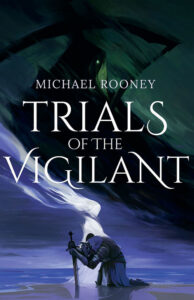
Novels are ideal for deeply personal, complex stories because they allow readers to spend more time with characters. That’s why Trials of The Vigilant became a novella. Sir Amos’ story centers on patience, determination, and redemption, and those themes benefit from a slower, more immersive format.
Comics, on the other hand, are perfect for Venator. It’s a highly stylized, action-driven story, and comics excel because of their visual storytelling. They work especially well for action, horror, and heroic adventures.
One advantage comics share with animation is the ability to express emotion in ways live-action sometimes can’t. Many characters in Arsturia wear helmets or masks, but artists can subtly alter their expressions through the artwork, much like Spider-Man or Spawn, to communicate emotion.
Film remains my favorite storytelling medium because it combines many strengths of books and comics while adding music, sound, and performance. It’s incredibly difficult to do well, but when everything comes together, film can inspire audiences in a unique way.
Ultimately, I hope many of our stories become films or television projects, but filmmaking requires far greater resources than publishing books or comics.
Nerd Street: Creating and publishing original intellectual property independently comes with unique challenges. What have been some of the most valuable lessons you’ve learned along the way?
Rooney: Independence comes with obvious challenges. We don’t have a major corporation funding us or a large network of investors. What we do have is adaptability, patience, and passion.
Adaptability allows you to overcome obstacles. Things rarely go according to plan, but if you’re willing to adjust, setbacks often become opportunities.
Originally I only wanted to direct large fantasy films, but I didn’t have the resources. So instead, I made a smaller film, then began writing novels for the stories that couldn’t yet be filmed, which eventually led to comics. What initially felt like scaling back actually became a stronger long-term business model.
Patience is equally important. I often encourage young creators to spend a little more time preparing and raising a little more money. In independent publishing and filmmaking, even small improvements in resources can dramatically improve the final product.
Finally, passion is what keeps you moving forward. Whether things are going well or falling apart, passion is ultimately what determines whether your dream survives.
Nerd Street: Strong worldbuilding is at the heart of many memorable stories. What is your approach to creating settings, characters, and lore that audiences can connect with?
Rooney: Building Arsturia means focusing on the details. Even though it’s a vast fantasy world, I spend a tremendous amount of time researching history, listening to music, and developing cultures, architecture, traditions, heraldry, and even clothing. Those small details help make the world feel lived in.
Characters are just as important. I constantly ask myself, “Why should readers care about this character?”
Often that begins with talent or unrealized potential. Readers are naturally drawn to characters who possess remarkable abilities or the possibility of greatness. That’s certainly true of Isaac the Fiend-Slayer. But talent alone isn’t enough. Once readers are invested, it’s the character’s journey that keeps them engaged. A compelling arc is ultimately more important than simply being cool.
Nerd Street: In an entertainment landscape dominated by established brands and franchises, what does it take to get readers and viewers invested in entirely new worlds and characters?
Michael Rooney: Passion has to be visible in every story you tell. You also have to think like the audience. If someone is seeing your work for the first time, you only have a few seconds to grab their attention.
Everything we create—from our covers to our posters to our trailers—needs to immediately communicate who we are.
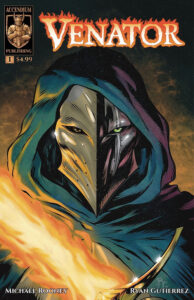
For example, the cover of Venator #1 focuses tightly on Isaac’s helmet and flaming sword. It isn’t simply about making an exciting image. It’s about instantly telling readers they’re looking at a dark, heroic, character-driven fantasy story.
Nerd Street: You’ll be exhibiting at Long Beach Comic Con this year. What can attendees expect to find at your booth, and what are you most excited to share with fans?
Michael Rooney: People often say our booth looks like the entrance to a castle or dungeon.
If you want to step into the world of Arsturia and experience The Chivalrous Epics, we’ll be there ready to welcome new adventurers.
Visitors can pick up several issues of Venator, copies of Trials of The Vigilant, collector’s edition DVDs of Cedric & Alysia, along with exclusive posters, apparel, stickers, and trading card accessories.
Lan Pitts: As Accendium Studios continues to grow, what creative goals or projects are you most excited to pursue in the years ahead?
Michael Rooney: We have several new novels and comics currently in development, along with a tabletop board game that’s nearing completion.
Beyond that, I’d love to see Trials of The Vigilant adapted into a feature film. I think it’s a story that would translate beautifully to the screen. Whether that happens will depend on time and how the audience continues to embrace the work we’re creating.
