Long Beach Comic Con returns to the Long Beach Convention Center on September 5–6, bringing together comic creators, collectors, retailers, cosplayers, and fans for a weekend celebrating every corner of comic book culture. Whether you’re hunting for key issues, meeting industry talent, or discovering your next favorite series, the annual convention has become one of Southern California’s premier destinations for comic enthusiasts.
Few people understand the hobby from as many angles as Brett Carreras. A lifelong collector, veteran comic dealer, and owner of VA Comicon, Carreras has spent decades buying, selling, and preserving some of the hobby’s most sought-after books while helping build communities around comics. Ahead of his appearance at Long Beach Comic Con, Nerd Street Director of Comics Lan Pitts caught up with Carreras to talk about his lifelong passion for collecting, the evolution of comic conventions, and what fans can expect when they stop by his booth this September.
Nerd Street: Brett, you’ve been buying, selling, and collecting comics for decades. What first sparked your love of comics, and what keeps that passion alive today?
Brett Carreras: Great question! I was a little late to comics. I was 12 years old when I really got into them. Batman (1989) had come out the year before, which is how I learned comic book stores even existed. For me, that was Dave’s Comics in Richmond, Virginia, one of the premier retailers at the time. I had also been subscribing to MAD Magazine since I was eight, without realizing it was all part of the same larger world.
One day I was in Waldenbooks and spotted a spinner rack. Justice League America #39 caught my eye. The cover had this giant red guy—Despero—choking a giant green guy—Martian Manhunter—with the word balloon, “What are YOU looking at?” It completely blew my little pea brain. I had to have it.
Then, at the end of the issue, the villain killed a guy named Mister Miracle, and I had to wait another 30 days to find out what happened. What a cliffhanger! The Adam Hughes artwork and the Giffen and DeMatteis writing definitely helped hook me.
The following year, a small science fiction bookstore called Novel Futures opened within biking distance of my house. My allowance was exactly $2.10 a week—enough for two comics plus tax—and every week I faithfully bought my two books. Two years later, Barnes & Noble opened nearby and put the shop out of business. Before they closed, they gave me their entire comic inventory—six boxes and a spinner rack—as a tax write-off because, as they told me, I “clearly loved comic books more than anyone they had ever met.”
Today, my biggest thrill is finding the world’s best copies of comics from the eras I love most: the 1980s and ’90s. I work primarily with two auction house clients, helping bring exceptional comics to market. The rare and unusual still gets my adrenaline pumping. Just today I learned I’d uncovered an exceptionally rare Pokémon comic. I was too old to experience Pokémon at its peak, but getting to broker a one-of-a-kind item is still incredibly exciting. And honestly, comic dealers get just as much of a rush buying great books as collectors do.
Nerd Street: As both a lifelong fan and the owner of VA Comicon, how has your perspective on comic conventions changed over the years? What does running a convention mean to you personally?
Carreras: No easy questions here!
While I’m the current owner of VA Comicon, it actually began as the Chesterfield Richmond Comic Collectors Club, founded by my friend Guy Rose. We were partners for years, and when he retired, he made me a very generous offer to take over. He still sets up at the shows today.
I’ve seen every version of comic conventions in my hometown, from tiny local events to massive shows. About a decade ago, I asked myself, “What part of this hobby isn’t being served by the larger media conventions?” My answer was to go in a completely different direction.
I eliminated celebrity guests, panels, signings, and photo ops, turning VA Comicon into a retail- and cosplay-focused event. At our shows, the exhibitors are the primary attraction, and the attendees are the secondary attraction. The event itself is the guest of honor.
Thankfully, that approach has resonated. We welcome thousands of fans every year across our three-plus annual events in Virginia.
Ultimately, I run the exact kind of convention I want to attend: a $15 show packed with the best comic books in the state and around 100 vendors offering something for everyone—even if comics aren’t your main interest.
Nerd Street: Comic conventions have become much more than places to buy comics—they’re communities. What do you think makes a great comic convention experience for fans?
Carreras: The most important job for any promoter is simple: meet your fans’ expectations. That’s what we try to do every single show.
Because we don’t rely on celebrity guests or VIP packages, we don’t have to worry about cancellations or disappointing fans. We also eliminated cash prizes from our cosplay contests, which made the atmosphere much more welcoming and less competitive.
There are other shows doing fantastic work, too. Twin Cities Con and Alaska ComiCon have outstanding community-building programs that I really admire.
As VA Comicon approaches its 40th anniversary, my biggest message is simply, “Thank you.” Our fans have grown up with us.
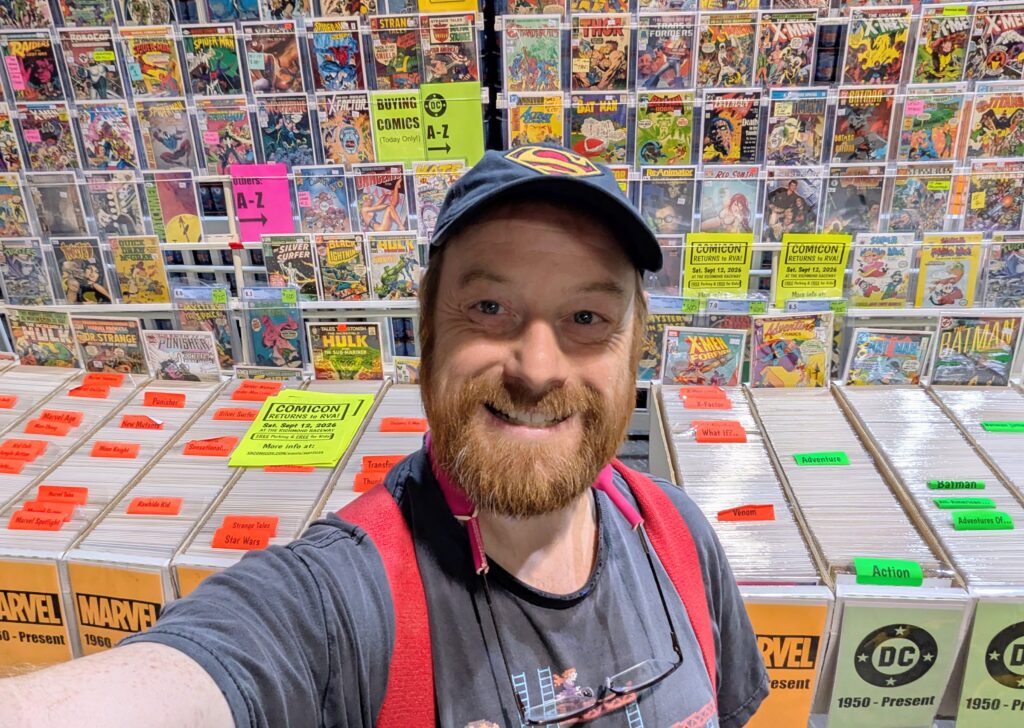
One thing that’s a little unusual is that I personally appear in all of my event advertising. I want the shows to feel approachable and accessible. I’m proud that we’ve built something a little different in this industry.
Nerd Street: You’ve seen the hobby evolve through speculation booms, grading, streaming adaptations, and new generations of readers. What excites you most about where comic collecting is headed?
Carreras: Look, I’m an old guy. I don’t understand everything. I don’t have TikTok, Twitter, Reddit, or any of that.
What I do believe is that the economics of this hobby will increasingly be driven by technology. As newspapers disappear and printing costs continue to rise, predicting the future of the market is almost impossible.
What won’t change is that fans will always want something special and unique.
That’s why so many creators are embracing platforms like Whatnot, Kickstarter, and Indiegogo. Those tools let creators connect directly with fans and make the experience personal, especially for people who can’t attend conventions.
As for grading, I’m firmly part of that world, whether I wanted to be or not. If you’re presenting the very best comics to the market, third-party grading through CGC has become the standard.
Nerd Street: You’re heading to Long Beach Comic Con. What are you most looking forward to, and what can fans expect if they stop by your booth?
Carreras: What am I looking forward to most? Escaping Virginia!
I’ve missed California ever since my landlord sold the house I was renting in San Francisco and I had to move back East.
Fans who visit my booth will find a carefully curated selection of around 3,000 comics, mostly in mint condition from the 1980s and ’90s. Everything is double-boarded in Mylar because I’m pretty obsessive about conditions. The best part? Most of my inventory is priced under $20.
Every comic has a story, and I remember where I found almost every one of them. Come by, say hello, and let’s talk comics.
Nerd Street: For someone attending Long Beach Comic Con for the first time, what’s your advice for making the most of the weekend—whether they’re hunting for key issues, meeting creators, or just enjoying the atmosphere?
Carreras: Start by checking the Long Beach Comic Con website and make a plan before you arrive. Also, set yourself a budget. At my first few conventions, I spent every dollar I had before I even reached the third booth.
Don’t be afraid to comparison shop, and figure out the difference between what you need and what you want. Focus on the must-haves first.
And remember, some of us are traveling across the country to bring these books with us. If you find something you love, don’t wait too long—we’ll eventually pack it all up and take it home for another year!
Nerd Street: After all these years in the hobby—as a collector, dealer, and convention promoter—what do you hope fans take away from events like VA Comicon and Long Beach Comic Con? Why do you think these gatherings remain so important to comic culture?
Carreras: I hope people leave happier than when they arrived.
I hope they feel energized by being surrounded by people who share their passion. I hope they feel included in everything they want to participate in. And after a full day of comics, cosplay, shopping, and conversations, I hope they’re completely exhausted—in the best possible way.
These events matter for the same reason going to the movies matters: if people don’t show up, they eventually stop happening.
Conventions rely on their communities. If we don’t do a great job, fans won’t come back. That’s why feedback matters. Constructive criticism helps us improve, but constructive praise is just as valuable because it tells us what we’re doing right.
And if you came to meet a favorite creator or special guest, let both the organizers and the creator know. Everyone appreciates hearing that their work made someone’s day. That kind of encouragement goes a long way.
